Galley slavery
Don QuixoteGalley slavery in Don Quixote is forced service aboard the king’s galleys, imposed on people condemned for crimes and dramatized as a conflict between lawful punishment and the loss of personal freedom. The chained prisoners whom Don Quixote encounters are not simply a backdrop for a fight: their condition tests his duty to aid the oppressed against Sancho Panza’s insistence that royal justice is punishing them. An embedded account of Christian captivity in Algiers widens the subject beyond this roadside encounter, describing galley labor alongside imprisonment, ransom, and efforts to escape.
Definition and Conditions
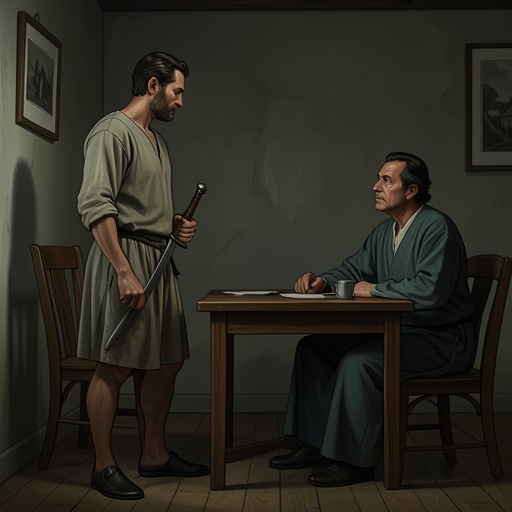
The episode involving the galley chain establishes the practice in concrete terms. A group of roughly a dozen men is being marched on foot, linked by the neck to a large iron chain and manacled, under the guard of armed men. Sancho identifies them as condemned criminals being taken by force to the king’s galleys. Their forced destination is central to Don Quixote’s response: he treats the fact that they are being taken against their will as a call to exercise his knightly office.
The embedded captivity narrative describes a broader system in which Christian captives in Algiers faced different conditions according to their status and prospects for ransom. Captives held by the authorities, those belonging to private owners, and people classified as municipal property could all be confined in a prison called a bano. The last group, assigned to public works and other employment for the city, had particular difficulty securing release because there was no individual master with whom to negotiate a ransom. Captives listed for ransom might be kept in the bano rather than sent out to work; if a ransom was delayed, they could be compelled to labor, including gathering wood. The account therefore distinguishes galley service from other forms of captivity without presenting either as freely chosen.
The Encounter with the Chain
When the prisoners reach Don Quixote and Sancho, Don Quixote politely asks the guards why they are being taken in chains, then requests that he hear each prisoner’s account separately. The guards initially refuse to explain beyond identifying the men as the king’s galley slaves. Sancho cautions that the king is not using force unjustly: the prisoners have been sentenced for crimes. Don Quixote, however, keeps returning to the visible fact that the men are being carried somewhere against their will. The disagreement is not about whether they are under sentence, but about whether that sentence settles the question of what a knight should do.
After listening to the prisoners, Don Quixote reasons that their punishment may have followed from unequal resources or failures of justice: one man’s inability to withstand torture, another’s lack of money, another’s lack of advocacy, or a judge’s perverse judgment. He does not establish that every prisoner is innocent; instead, he treats the possibility of unfairness and the coercive character of their destination as grounds for intervention. He first asks the guards and commissary to release them peacefully, arguing that the king can find other servants under better circumstances. When the commissary refuses and mocks him, Don Quixote attacks him with his lance.
The attack turns a dispute over justice into a physical break in the chain’s control. The guards move against Don Quixote, but the prisoners seize the opportunity to free themselves by breaking the chain. Sancho helps Gines de Pasamonte get loose; Pasamonte takes the fallen commissary’s sword and musket and drives the guards away without firing the weapon, while the escaped men pelt them with stones. The guards’ divided effort to face both Don Quixote and the prisoners leaves them unable to regain control. Sancho immediately worries that the fugitives will summon the Holy Brotherhood of Toledo and urges his master to flee toward the nearby sierra.
Freedom, Obligation, and Aftermath
Don Quixote does not treat the escape as the end of his involvement. He gathers the freed men and asks them to go to El Toboso, still wearing the chain he has removed, and tell Dulcinea del Toboso the details of the adventure. His demand converts their release into a service owed to him, revealing a comic mismatch between the prisoners’ immediate freedom and the knight’s expectation that they will perform a chivalric errand. They refuse, and the rescue does not produce the grateful, orderly conclusion Don Quixote imagines. The freed men instead turn against him and Sancho, pelting them with stones and taking their belongings before dispersing.
The episode thus refuses to make liberation uncomplicated. Don Quixote recognizes coercion but acts on a partial understanding of the prisoners’ histories; Sancho recognizes the force of the legal sentence but anticipates the practical danger created by breaking it. The escape leaves the travelers exposed to retaliation and makes clear that freeing people from one authority does not ensure their gratitude, safety, or compliance. The chain functions at once as the instrument of forced transport and as a visible sign through which Don Quixote turns a complicated legal situation into an immediate chivalric cause.
Captivity Beyond the Roadside Episode
The novel’s embedded account of Christian captivity places forced galley labor within the larger realities of capture and attempted escape. Its narrator recalls being taken during a naval battle after boarding an enemy galley in support of another vessel. He describes the Christian captives who were made to row, then recounts his transfer to Algiers and confinement among prisoners held for ransom. In that account, a chain could mark a captive’s status as a person awaiting ransom rather than serve simply as proof that he was being sent to row; delays could nevertheless bring forced labor. This distinction gives the novel’s treatment of bondage more than one form and setting.
The captivity narrative also connects forced service to collective resistance. Its narrator and fellow Christians plan an escape with help from a renegade and coordinate their actions with a vessel waiting off the coast. On the appointed night, the party first secures the vessel and its Moorish rowers, then makes its way to Hadji Morato’s garden to bring Zoraida out. The operation depends on cooperation, secrecy, and a narrow opportunity, not on an individual’s command over events. Across the roadside rescue and the captivity account, freedom is portrayed as something people may seek and sometimes seize, but whose pursuit remains bound to danger, unequal power, and uncertain consequences.